Congress Is About to Fix the Clocks Wrong for the Third Time
The House has voted to make daylight saving time permanent. We tried this in 1974. It was dark.
PSA·
On July 14, the House of Representatives voted 308 to 117 (opens in a new tab) to make daylight saving time permanent. The bill is called the Sunshine Protection Act, because the one thing Washington still manufactures domestically is names. The Senate takes it up when it returns on September 14, the President has demanded — in capital letters — that it pass, and the whole thing has the comfortable feel of a long national annoyance finally being handled.
It is the third attempt at this exact fix. The first lasted eight months of a planned two years. The second passed the Senate because nobody answered an email. The third is happening now, in the open, with the records of the first two filed exactly where nobody intends to look — and the fix being locked in is the less popular of the two replacements on offer, the one the sleep scientists specifically recommend against.
What the bill actually does
The Sunshine Protection Act does not, strictly speaking, make daylight saving time permanent. It does something more elegant: it repeals the section of federal law (opens in a new tab) that creates daylight saving time, then moves every American time zone forward one hour, so that the abolished thing continues indefinitely under a new name. Eastern Standard Time becomes what Eastern Daylight Time is now. Daylight saving time is eliminated the way a fugitive is eliminated by a new passport.
In practice: the March and November clock changes end, which most of the country wants. Winter evenings gain an hour of light and winter mornings lose one — a trade the press releases describe exactly half of. Senators from the northern and western edges of the time zones have been noting that January sunrise would arrive around 9 a.m. in Seattle (opens in a new tab) and closer to 9:30 in parts of Montana. Arizona and Hawaii, which never observed daylight saving in the first place, are permitted to keep their clocks where they are and watch.
Attempt one: 1974
We have run this experiment at national scale. In December 1973, mid–oil crisis, Congress put the whole country on year-round daylight saving as a two-year energy trial, and Nixon signed it. It took effect on January 6, 1974, with 79 percent of the public approving (opens in a new tab). By the end of February, approval stood at 42 percent.
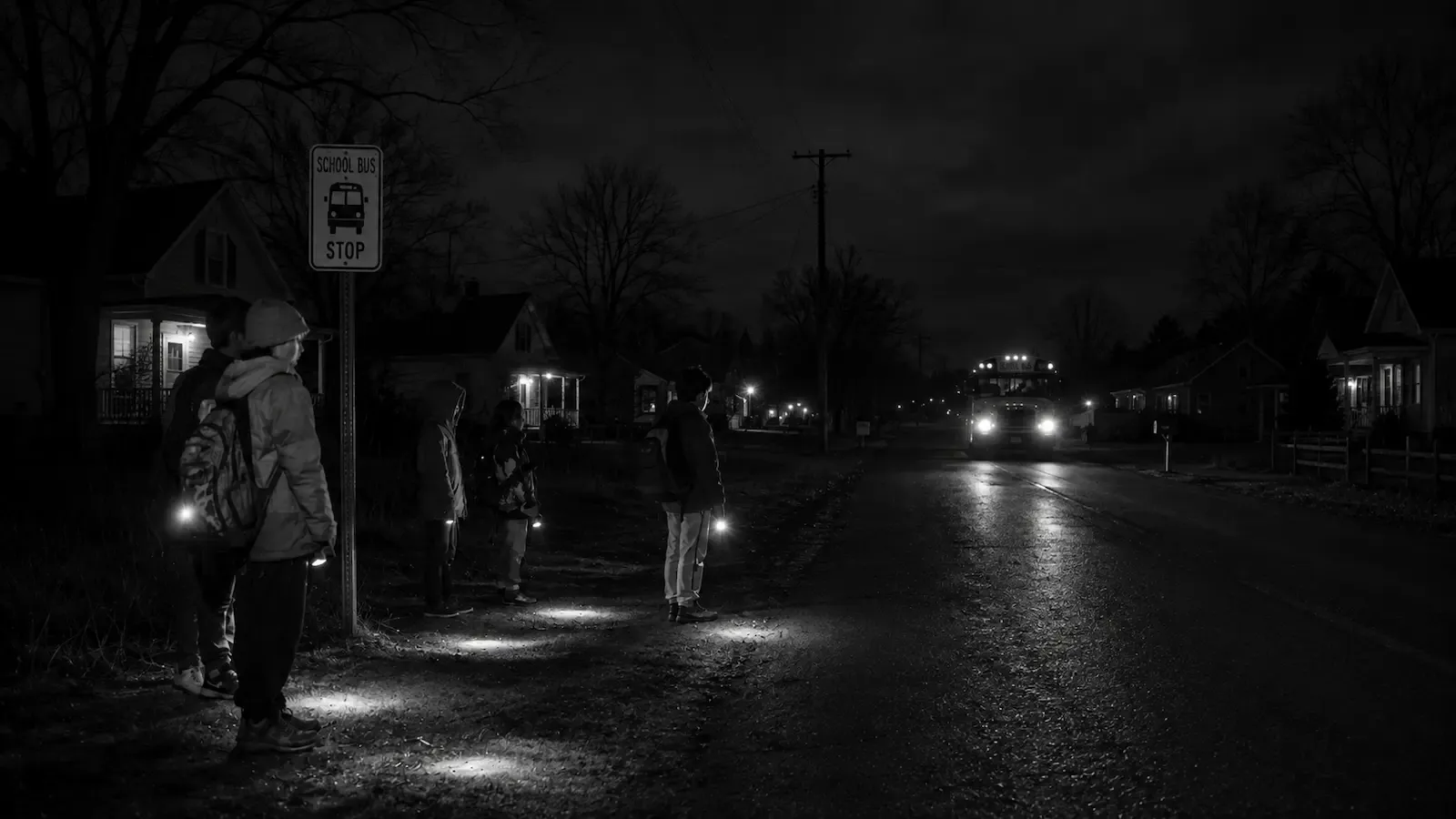
The problem was the mornings. January sunrise came as late as nine o’clock in parts of the country, children carried flashlights to the bus stop, and newspapers of the period reported some of them struck and killed in the dark. Parents discovered they preferred the clock change to the alternative with a speed that embarrassed the pollsters. Congress repealed the experiment that October, eight months into the two-year trial, and Ford signed the repeal. Nothing about the position of the sun has been amended since.
Attempt two: 2022
The Senate passed this same idea on March 15, 2022, unanimously, and the explanation — which took three years to arrive on the Senate floor — is one of the most honest documents Congress has produced this century. When a senator asks to pass a bill by unanimous consent, an email goes out to all one hundred offices asking whether anyone objects; silence counts as yes. On this occasion the silence was total, and the United States Senate advanced a permanent, nationwide change to the measurement of time because nobody replied to a thread.
Senator Tom Cotton (opens in a new tab), who opposed the bill, delivered that explanation himself: he had never told his own staff how strongly he opposed it, and had assumed a colleague would object instead. “I take full responsibility for this mistake, though the search for someone else to blame is actively ongoing.” BuzzFeed News collected the other survivors’ accounts — senators who had no idea the vote had happened, staff who had decided their bosses wouldn’t care. The bill went on to die in the House, which Cotton says he helped arrange. The email system remains in service.
The energy argument
Daylight saving time exists because Germany needed to ration coal in 1916, in the middle of the First World War. The United States adopted it in 1918, taking time-management advice from a country it was at war with at the time. The repeal came in 1919, over Wilson’s veto, after farmers — the people the policy is folklorically for — led the opposition; the Grange priced the law at 10 percent of a farm’s operating costs. The policy has been rearranged more or less continuously ever since, and the energy rationale is the one constant across the century of tinkering. It is also, at this point, measurably false.
When Congress last extended daylight saving, the Department of Energy went looking for the savings and found 0.03 percent of annual electricity consumption (opens in a new tab). When economists studied Indiana households as the state switched over, electricity use went up about one percent (opens in a new tab), the lighting savings erased by heating and air conditioning, at a cost to Indiana households of about $9 million a year.
The policy invented to save fuel spends it. We have kept the ritual a century past the reason.
What people actually want
The switch itself has earned the hatred: in the week after the spring change, fatal-crash risk rises about 6 percent (opens in a new tab) — roughly 28 deaths a year — before fading as bodies adjust. Ending the switch is the one point where the public, the Senate and the scientists genuinely agree. Then comes the question of which time to keep, and the agreement ends.
A January 2025 Gallup poll (opens in a new tab) found 48 percent of Americans want permanent standard time, 24 percent want permanent daylight time, and 19 percent want to keep switching, the civic equivalent of enjoying hold music. The bill enacts the 24 percent option. The American Academy of Sleep Medicine (opens in a new tab), with twenty medical and scientific organizations co-signing and the American Medical Association alongside, recommends permanent standard time, the option that matches human circadian biology. That option has no bill.
None of this is hidden. The clocks keep getting fixed wrong because “stop changing the clocks” is two opposite policies wearing one slogan, and all of us have spent decades chanting the slogan while refusing to pick. Before you write in to say you would happily take either so long as the switching stops: you people are how this bill got out of committee. The President has covered both positions personally — in December 2024 (opens in a new tab) he pledged to eliminate daylight saving time, and this month (opens in a new tab) he ordered the Senate to pass it forever. He is, on this issue, a perfectly representative American.
September, then January
The Senate returns on September 14 with everything it needs: one failed national experiment, one accidental dress rehearsal, one poll showing the country prefers the other repair, and a majority leader who is not sure the votes exist (opens in a new tab). If sixty senators agree, the clock changes end and the nine o’clock January sunrise begins. In 1974 the country needed less than two months to decide it had made a terrible mistake. There is no reason to believe we have gotten slower.
Receipts
- H.R. 139, Sunshine Protection Act of 2025 — engrossed text (opens in a new tab)
- House Clerk, Roll Call 238, July 14, 2026 (opens in a new tab)
- Sen. Tom Cotton, floor speech opposing the Sunshine Protection Act (opens in a new tab)
- Department of Energy, Impact of Extended Daylight Saving Time on National Energy Consumption (2008) (opens in a new tab)
- Kotchen & Grant, Does Daylight Saving Time Save Energy? (NBER) (opens in a new tab)
- Fritz et al., Current Biology (2020), on DST transitions and fatal crashes (opens in a new tab)
- American Academy of Sleep Medicine, position statement on permanent standard time (opens in a new tab)
- Gallup, January 2025, on ending daylight saving time (opens in a new tab)