Nobody Ever Said Eight Glasses, and We Found Who Nearly Did
The number is real. The paragraph went on to say most of it was already in your food, and that thirst would do. We read that far.
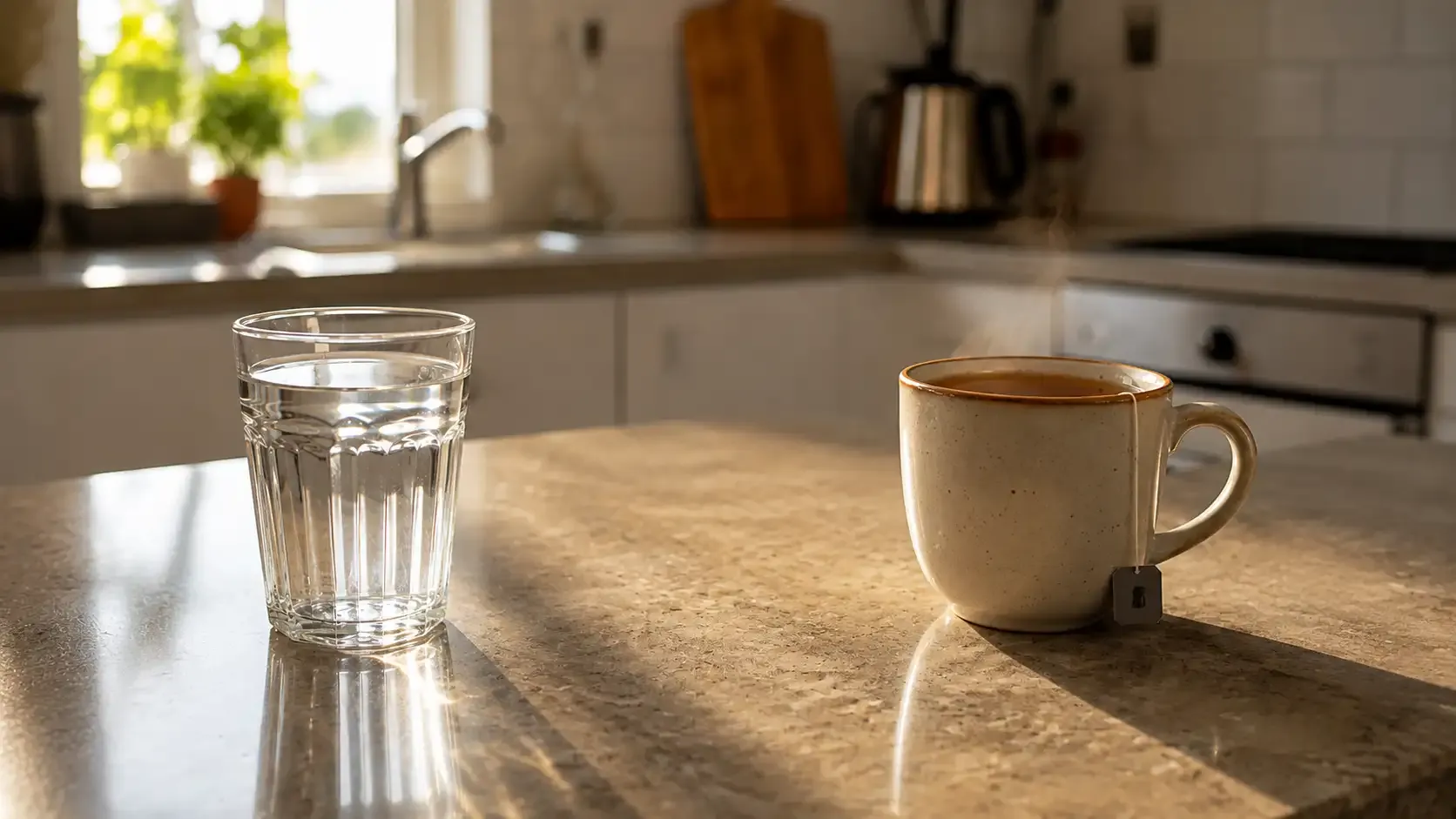
Nobody in authority has ever told you to drink eight glasses of water a day, and we went looking for who did. The nearest thing we found is one paragraph in a 1945 pamphlet from the US National Research Council that said two and a half liters, said most of that was already in your food, and said to drink when you are thirsty — in that order, in seventy-five words. The number survived. The other two sentences did not.
You know the number. You own a bottle with the hours printed up the side and small encouragements between them, and at some point this afternoon you will drink from it not because you want to but because it is half past two and the bottle says so. We have the same bottle. It was a gift, which is what everyone says.
Somebody in your office announces at about three that they have not drunk enough water today, in the tone of a weather report. You nod. You have not either.
Where the number comes from
In August 1945 the Food and Nutrition Board of the US National Research Council issued its revised Recommended Dietary Allowances (opens in a new tab) as a pamphlet, available without charge to anyone who wrote to the Board and asked. Water is not in the allowance table. It gets one paragraph of text, after the one on salt. Here is all of it:
Water. A suitable allowance of water for adults is 2.5 liters daily in most instances. An ordinary standard for diverse persons is one milliliter for each calorie of food. Most of this quantity is contained in prepared foods. At work or in hot weather requirements may reach 5 to 13 liters daily. Water should be allowed ad libitum, since sensations of thirst usually serve as adequate guides to intake except for infants and sick persons.
That is the founding document, in its entirety: seventy-five words, and the world stopped reading at the twenty-ninth. The paragraph before it, on salt, opens by saying that the needs for salt and for water are closely interrelated, which is the kind of sentence a committee writes when it would like both subjects to be somebody else’s problem.
How 2.5 liters became eight glasses
The paragraph never says glasses. It gives a rule of thumb — one millilitre of water per calorie of food — and at 2,000 calories a day that is two liters, or 64 fluid ounces, or eight glasses of eight ounces (opens in a new tab). The 2.5 liters is the same sum for someone eating 2,500 calories. It was, in the Board’s own phrase, an ordinary standard for diverse persons: a ratio that rose with the diet, and most of the water, the Board said, arrived inside the diet.
Who first did the sum and kept only the answer is not recorded. Heinz Valtin, a professor of physiology at Dartmouth, went looking in 2002 — through the databases, then through the literature older than the databases, then by asking the nutritionists who might remember — and found no scientific study in support of eight glasses (opens in a new tab). His guess, per Dartmouth’s summary (opens in a new tab), was that the Board’s number got out and the sentence after it “may have been missed”. The hedge is on why; that the sentence exists is not in doubt, and neither is what became of it.
The nearest anyone has found in print is a 1974 nutrition textbook, as quoted at second hand, that told the average adult to take in “somewhere around 6 to 8 glasses per 24 hours” (opens in a new tab) — and, in the same sentence, said this could be coffee, tea, milk, soft drinks or beer. So the earliest book anyone cites for eight glasses counted beer, and the version that reached you came with a rider that coffee does not count. The advice mutated in the one direction that made it harder, which is the direction advice mutates.
What the sentence after it says
Go back to the paragraph. Most of this quantity, it says, is contained in prepared foods; then, water should be allowed ad libitum — as much as you like — “since sensations of thirst usually serve as adequate guides to intake”. The Board was not telling you to drink two and a half liters. It was saying that a body gets through about two and a half liters, mostly by way of dinner, and that the rest could be left to thirst.
You were not being stupid. A board of the National Research Council did say 2.5 liters; it meant it the other way round. Eighty-one years of the number, and now bottles with the hours on it, all because nobody read the next fucking sentence.
The Board itself went quiet on it, then came back softer. As far as a scan of the 1948 revision can be read, the water paragraph vanished from that edition altogether; the 1953 revision (opens in a new tab) brought it back almost word for word and changed “Most of this quantity” to “Much of this quantity” — one word, softened, eight years on, in a document nobody was reading past the table either. It also added that in extreme heat thirst may not keep pace and a liter an hour may be needed for a while: the exception the Board saw coming, and the one the slogan never mentions.
What the numbers are now
Before you write in to say that most of your water does not come from food: correct, and so says everyone who has measured it since: the US Institute of Medicine’s 2004 report (opens in a new tab) put food at about 20 percent of total water and drinks at 80; Harvard (opens in a new tab) says the same fifth. In a 1977–78 national survey (opens in a new tab) it was 28 percent, so the share has been drifting for a while. Whatever the Board counted as “prepared foods” in 1945 — the pamphlet does not say whether soup and coffee were foods — it is not most of your water now. What survived intact is the half that matters: every figure, then and since, counts everything you drink, and most of them count the food too.
Those figures are also larger than eight glasses, and nobody enjoys that part. The Institute of Medicine’s adequate intake is 3.7 liters a day for young men and 2.7 for young women (opens in a new tab), from all food and drink, caffeinated drinks included, with no upper limit set (opens in a new tab) because healthy kidneys excrete the surplus. Europe’s food safety authority says 2.5 and 2.0 (opens in a new tab), total, again counting “beverages of all kind” and “food moisture”. The NHS (opens in a new tab) says six to eight cups of fluid, lists tea and coffee among the fluids, and then gives the actual test, which is whether your urine is a clear pale yellow — an entire health service, reduced to asking you to look.
You are, without trying, most of the way there. In the national survey of 2009 to 2012, American men took in 3.46 liters a day and women 2.75 (opens in a new tab), and only about a third of it was plain water; the rest was everything else they ate and drank. Nobody in that survey was following a rule. They were having lunch.
What the evidence supports
Valtin’s review found no study behind eight glasses and surveys of thousands of healthy adults getting by on less, and it said that caffeinated drinks count toward the total and, within reason, so does beer. It also said exactly where the conclusion stops: healthy adults, temperate climate, largely sedentary — that is, you, and us. Hard exercise, heat and some diseases call for a great deal more, and the 1945 paragraph said so first, with its five to thirteen liters for a day at work or in hot weather. The exceptions were in the original; only the rule was invented.
On thirst, Dartmouth’s summary of his paper puts it this way: thirst begins when the concentration of the blood has risen by less than two percent, and dehydration is usually defined as beginning at five. The alarm goes off before the fire. That is the point of alarms. The Institute of Medicine’s report says the same in its own register: day to day, fluid intake driven by thirst and by drinking at meals is what keeps a healthy person hydrated (opens in a new tab).
The largest measurement of the question came in 2022, when an international team tracked water turnover in 5,604 people (opens in a new tab), from eight days old to 96, in 23 countries, by following an isotope of hydrogen through them. Turnover ran from about one liter a day to six (opens in a new tab), with some people near ten, and moved with age, body size, activity, pregnancy, altitude, temperature and humidity — with everything, then, except a bottle. The University of Aberdeen’s summary (opens in a new tab) called eight glasses probably too much for most people in most situations, and said one size for all “is not supported by these data”.
Turnover is not what you must drink, either. John Speakman, one of the authors, worked through a man in his twenties turning over 4.2 liters, about 15 percent of which the body makes for itself or exchanges through the skin, leaving about 3.6 to come in — “a substantial amount” of it, he noted, “just by eating”. The Board said that in 1945, in fewer words, for free.
What the evidence supports is the sentence nobody reached. Thirst is an adequate guide, the paragraph said, except for infants and the sick, who have someone else in charge of it, and for anyone at work in the heat, who was told to drink a great deal more and should. The rest of us have a bottle with the hours on it, and took it to a meeting this morning. It is half past two, and we are, regrettably, not thirsty.
Receipts
- Recommended Dietary Allowances, Revised 1945 — NRC Reprint and Circular Series No. 122 (scan) (opens in a new tab)
- Recommended Dietary Allowances, Revised 1953 — NAS–NRC Publication 302 (Internet Archive) (opens in a new tab)
- Valtin, “Drink at least eight glasses of water a day.” Really?, Am J Physiol Regul Integr Comp Physiol 283: R993–R1004 (2002) (opens in a new tab)
- Institute of Medicine, Dietary Reference Intakes for Water, Potassium, Sodium, Chloride, and Sulfate — chapter 4, Water (opens in a new tab)
- EFSA, Scientific Opinion on Dietary Reference Values for water, EFSA Journal 2010;8(3):1459 (opens in a new tab)
- NHS — Water, drinks and hydration (opens in a new tab)
- NCHS Data Brief 242 — Daily Water Intake Among U.S. Men and Women, 2009–2012 (opens in a new tab)
- Yamada et al., Variation in human water turnover associated with environmental and lifestyle factors, Science 378: 909–915 (2022) (opens in a new tab)