The FCC Has Abolished a Speed Goal Nobody Was Required to Meet
It was aspirational, it had no deadline, and both the FCC that set it and the FCC that scrapped it agree it decided nothing. The rest of the report is where your money went.
PSA·
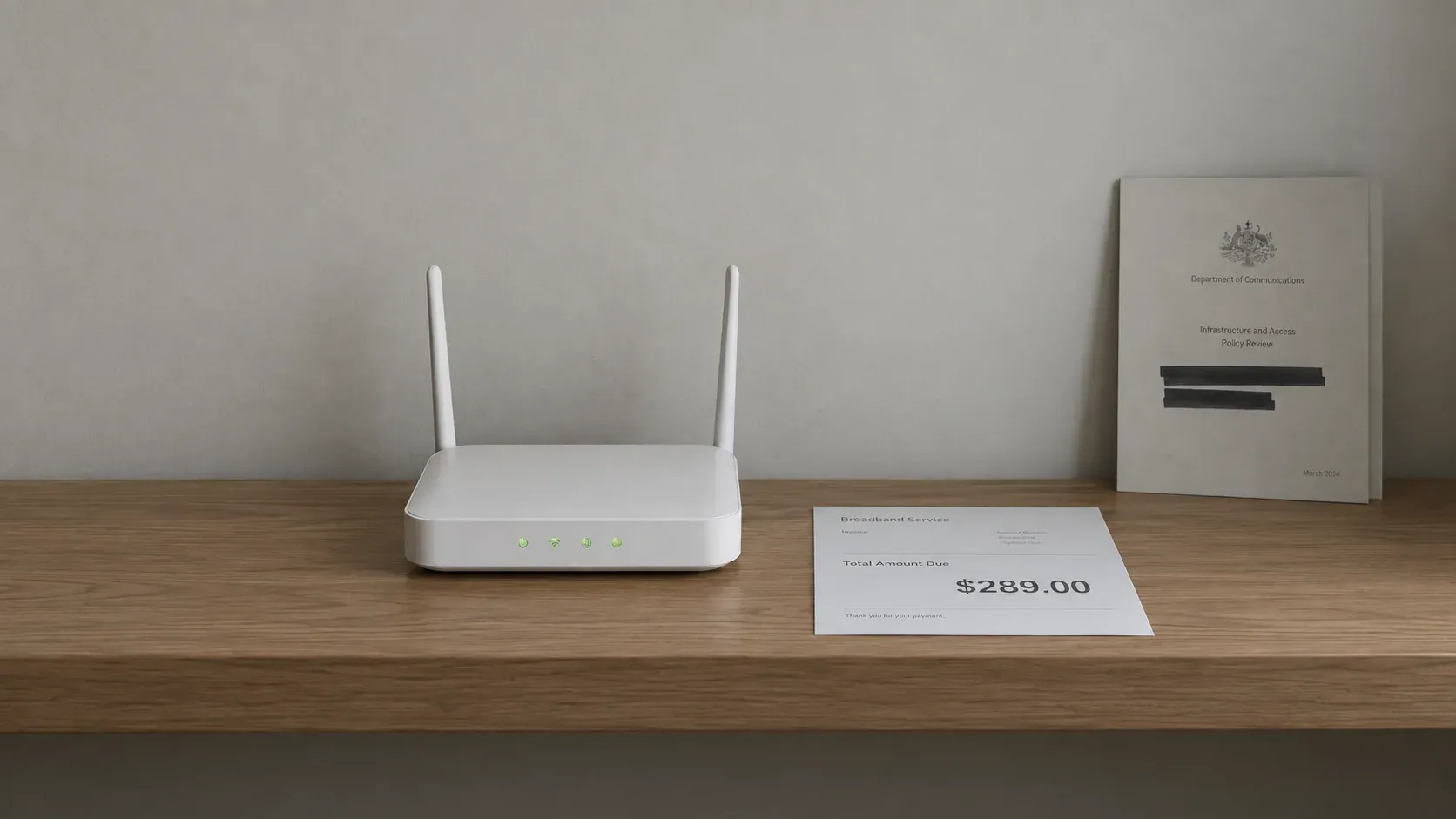
On August 14 the Federal Communications Commission released its annual report to Congress on whether fast internet is reaching everyone, and deleted from it a goal, written in by its predecessors in 2024, of one gigabit down and 500 megabits up. The coverage mourned the gigabit. The FCC said the goal risked violating its duty of technological neutrality, a duty it turned out to owe to satellites.
The goal was a sentence in a report. The FCC that wrote it called it “aspirational” (opens in a new tab) and said it would not be used for its finding; the FCC that deleted it said it “does not serve any positive purpose.” (opens in a new tab) Two commissions, two chairs, one point of agreement: nobody was ever owed a gigabit by this document, and nobody has lost one. The report is long. We read all of it, down to paragraph 136, which is the one that says the report is adopted, in case the previous 135 had left any doubt.
What the goal was for
In March 2024 the FCC raised the speed that counts as real broadband from 25 megabits down and 3 up, where it had sat since 2015, to 100 down and 20 up. In the same paragraph it added a long-term goal of 1,000 down and 500 up, then spent a footnote explaining that the goal was “merely that – aspirational” (opens in a new tab), would not be used for the FCC’s finding, and need not rest on “a detailed projection of consumer needs.” A regulator set a target and, in the same breath, filed the paperwork excusing itself from it.
The goal had no deadline. The 2024 report considered attaching one and decided to “initially observe market and investment trends” first, which is what people say about the gym. The number itself was borrowed from the FCC’s own funding programs, where it was already a condition of the money. The FCC’s data at the time, from the end of 2022, showed gigabit-class service available to between 38 and 41 percent of households (opens in a new tab), and under 20 percent of those households paying for it. You, with the gigabit plan and the router from a previous administration, are that 20 percent. You are paying for the number on the box, and using it to watch a 720p stream you believe is 4K.
Then-Commissioner Brendan Carr dissented from the 2024 report and wrote that he hoped the goal was “not a Trojan Horse to exclude fixed wireless in a future report.” (opens in a new tab) He was worried the number would be smuggled in and used against wireless. It was not smuggled anywhere. It was left in the body of a report, in the open, where for two years nobody picked it up.
Why it went
Carr is now chairman, and in August 2025 his FCC proposed removing the goal, on the grounds that it “may be unreasonably prejudicial to technologies such as satellite and fixed wireless that presently do not support such speeds.” (opens in a new tab) That sentence names who benefits, in a numbered paragraph, with a footnote. It is the last time anyone at the FCC would be so specific.
A year later the final report deletes the goal for being unmentioned in the statute and for possibly violating “our obligation to conduct our analysis in a technologically neutral manner”, and adds that anyone suggesting the neutrality concern “merely serves to accommodate technologies that may currently offer slower speeds” (opens in a new tab) is mistaken. The 2025 sentence about satellite and fixed wireless does not appear. It was unreasonably prejudicial to the argument.
The cable industry’s trade group is quoted with approval, to the effect that speeds will keep rising “without regard to any artificial long-term goal established by the Commission.” The private sector, the report adds, “does not need the Commission to centrally plan technological development.” It did need the Commission to write that down, in a federal report, with a footnote citing the cable lobby, which is how the private sector says thank you.
Commissioner Anna Gomez wrote that “lowering standards to ensure certain technologies can meet a benchmark is the opposite of technological neutrality.” (opens in a new tab) The pitch on our own desk called that a dissent. It was a concurrence. She voted for the report, objected in writing, and signed off with “I respectfully concur”, which is the Washington form of a five-star review that says the soup was cold.
What decides whether you count as served
Before you write in about the Rural Digital Opportunity Fund: yes. Gomez raised it, and it is the best argument against everything above. The FCC’s rural fund has a gigabit tier, 1,000 down and 500 up, written into the Code of Federal Regulations (opens in a new tab), and the auction winners have committed to deliver it to roughly 98 percent of the 3.2 million locations (opens in a new tab) they were paid $5.75 billion to reach. That standard is binding. It is also a funding rule, in a different document, and this report did not touch it. The Americans who are owed a gigabit are owed it by companies that were paid to promise one, and the promise stands.
Everything else that decides whether your address counts was left where it was. The benchmark for the FCC’s own finding stays at 100/20; the report says the record “unanimously supports” it and that raising it would be “premature” while the $42.45 billion BEAD program is still built on it. BEAD’s definitions of unserved, below 25/3, and underserved, below 100/20, are not the FCC’s to change at all: Congress wrote them into the Infrastructure Act (opens in a new tab), one whole branch of government out of the report’s reach. The FCC’s map feeds those programs. Its gigabit sentence never fed anything.
A number that decided nothing has been removed by people who were correct that it decided nothing, for reasons they gave differently in two consecutive years. Your connection is the speed it was on August 13. If it feels slower, that is not the FCC. That is you, refreshing.
How the report counts you
The report finds that broadband is being deployed to all Americans in a reasonable and timely fashion (opens in a new tab), and the numbers it uses to get there come in three columns. Count only wires, and 93.9 percent of Americans can buy 100/20 service. Add fixed wireless, and it is 96.9. Add satellite, and the table prints 100.0 percent, a figure the text rounds down to 99.7, the way a person rounds down a bar tab.
The report is careful about the satellite column. Satellite is 2.3 percent of fixed connections, speeds “could depend on location, time of day, and type of service plan”, and so the figures are published with satellite and without. Gomez’s statement adds that fewer than half of satellite users (opens in a new tab) actually got 100/20 last year, and that in crowded areas providers have charged one-time demand fees of up to $1,500, which is a lot for a dish that gets slower every time a neighbor buys one.
Then there is choice. For wired service at 100/20, 5.7 percent of households have no provider (opens in a new tab) and another 40.6 percent have exactly one. One is the number of options at which a company can send an email with the subject line “Important changes to your plan” and know you will read it, sigh, and stay.
You know this column personally. It is ten past eleven, the house is asleep, and a speed test returns 61 megabits on a plan sold as a gig. The support chat asks you to restart the router. You were going to anyway, because you are a reasonable person who owns a gigabit plan and has moved twice without replacing the router. The test comes back at 58. The map says your address has three providers at 100/20, and the map is right. The map does not ask what happened at ten past eleven.
What the report stopped asking
The 2024 report had, for the first time, asked not only whether broadband was available but whether anyone could afford it, whether they had signed up, and whether access was equitable. The 2026 report calls its predecessor “a lone outlier” (opens in a new tab) that wandered from the statute, and removes all three questions. Availability is the word in the law, and availability, the report decides, means the wire reaches the pole.
It then reassures you anyway. “We do not minimize the importance of factors like affordability,” the report says, and continues: “evidence shows broadband prices are going down as the cost of living skyrockets along other dimensions.” That is the FCC declining to measure whether you can afford your internet, then telling you it is getting cheaper, in one fucking paragraph, on its way out of the room.
This is the removal that matters, and it is the one Gomez was objecting to when she concurred. Leaving out affordability and usability, she wrote, “was a policy decision with which I disagree.” (opens in a new tab) Section 706 is the government’s annual grade on whether the internet is reaching people. As of this year the exam has one question, it is about wires, and the answer is yes.
The gigabit goal had no deadline, no formula and no effect, and everyone involved knew it. Affordability had a place in the report, once, and now it does not, while 10.5 million people (opens in a new tab) still cannot buy a wired or fixed-wireless 100/20 connection at any price. The report also took 374 days to complete an inquiry the statute gives 180 days (opens in a new tab). There was, it turns out, one number in the building somebody was required to meet, and they missed it by 194 days.
What to do with this
Three things, all free.
Know your number. The speed that counts as broadband in America is 100 down, 20 up. It was that on August 13, it is that today, and it is what the FCC’s finding and the BEAD map measure your address against. If the ad says gigabit, that is a price. The benchmark is 100/20, and it is not for sale.
Check the map. The FCC’s National Broadband Map, at broadbandmap.fcc.gov, lists what providers say they can sell at your address. It is provider-reported, updated twice a year (opens in a new tab), which is a polite way of saying the companies grade their own homework, and this report was built on the June 2025 version before any consumer challenges were folded in. If the map says a company serves you and the company says it does not, you can file a challenge and FCC staff adjudicate it. That is the one place in this entire process where your experience of the internet is admissible.
Read your bill, because nobody in Washington will be reading it for you this year. The report will tell Congress you are served. It will not tell Congress what that costs, because it has stopped asking, and it will not tell you either. That number is on page two of a PDF you have never opened, from a company that has seen the same map you have and knows which column you are in, and the FCC has just concluded, without looking, that it is going down.
Receipts
- FCC 26-55, 2026 Section 706 Report (August 14, 2026) (opens in a new tab)
- Statement of Commissioner Anna Gomez on FCC 26-55 (opens in a new tab)
- FCC 24-27, 2024 Section 706 Report (March 14, 2024) (opens in a new tab)
- Dissenting Statement of Commissioner Brendan Carr on FCC 24-27 (opens in a new tab)
- FCC 25-46, Nineteenth Section 706 Report Notice of Inquiry (August 8, 2025) (opens in a new tab)
- 47 U.S.C. § 1302, Section 706 of the Telecommunications Act of 1996 (opens in a new tab)
- 47 U.S.C. § 1702, BEAD definitions of unserved and underserved (opens in a new tab)
- 47 CFR § 54.805, Rural Digital Opportunity Fund performance tiers (opens in a new tab)